You wrote a book. Great. Now comes the part nobody warns you about. Your book will not sell itself, even if your mom bought five copies.
This guide gives you 100 book marketing ideas to test in 2026, from free tactics to paid ads. The short answer is simple. Book marketing works when you know your reader, show up where they already spend time, and track what pays off.
Most authors do the reverse. They skip research, burn cash on ads, or hire book marketing agencies before they know what they need. Pick a few ideas, run them for 90 days, and keep only what works. Each idea has a Best for note, so you can match it to your book, budget, and publishing path.
Key Takeaways
- Marketing a book in 2026 requires smart planning and consistent action.
- You do not need a huge budget to succeed.
- Set clear goals and focus on steady marketing efforts.
- Explore 100 practical steps to reach more readers and sell more books.
- Learn how to improve book metadata and run simple ads.
- Discover ways to build an email list and get genuine reader reviews.
- Follow actionable tips to increase book sales throughout 2026.
Build a Strong Foundation for Your Book Marketing Strategy
Weak basics make every later tactic cost more. Fix these eight first, before you spend a cent on ads.
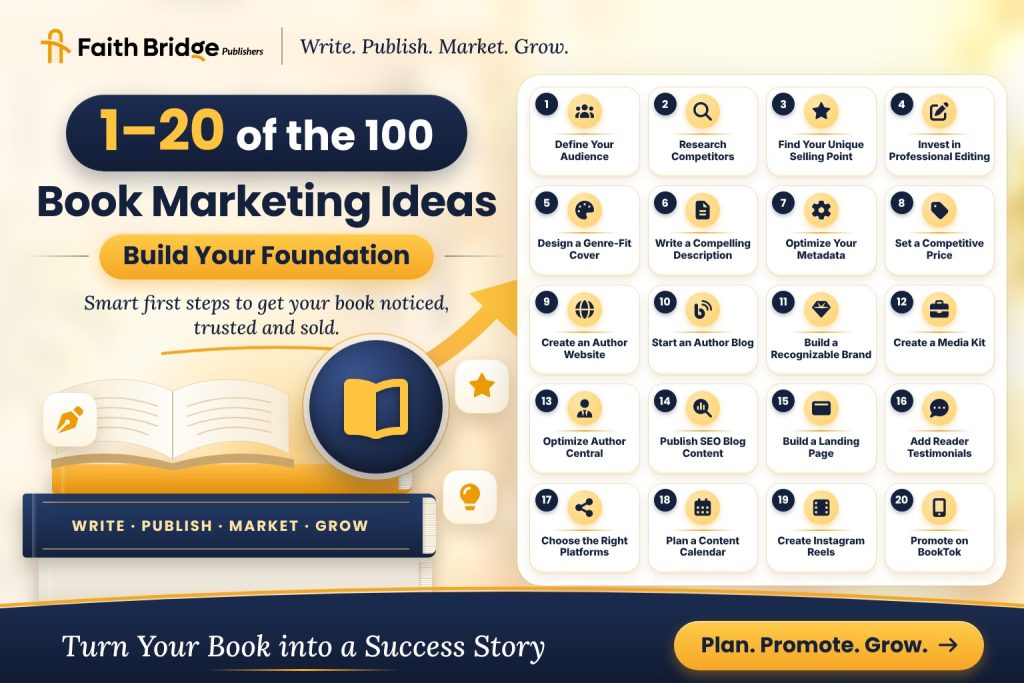
1. Define Your Book’s Target Audience
Write one sentence that names who needs your book and why. Include age, problem, and where they read. Then test it against real data, like Amazon’s also bought lists and Goodreads shelves. A fuzzy audience makes every ad weaker.
Best for every author, before spending a dollar.
2. Research Competing Books in Your Genre
Pick ten books that sell well in your genre. Note price, cover style, page count, review count, and title keywords. Look for gaps, like a missing topic or weak covers. Match what readers expect, then add one clear twist.
Best for self published authors choosing a niche.
3. Identify Your Book’s Unique Selling Points
A unique selling point (USP) is the reason a reader picks your book over ten similar ones. Finish this sentence. Unlike other books on this topic, mine does what? Use that answer in your description, ads, and pitch emails.
Best for nonfiction authors and faith based writers with a clear angle.
4. Invest in Professional Book Editing
Typos kill reviews. Hire an editor before launch. A developmental editor fixes story and structure. A copy editor fixes grammar and flow. Prices vary by length, so get two or three quotes and ask for a sample edit first.
Best for self published authors and first time writers.
5. Design a Genre Specific Book Cover
Readers judge covers in seconds. Study top sellers in your genre and match their color, font, and layout cues. Test two cover options with a small poll or ad. Check each cover at thumbnail size, because that is how stores show it.
Best for self published authors. Traditional authors can ask for input.
Ready to Boost Your Book Sales in 2026?
Stop relying on luck to reach your readers. Let our team of expert book marketers build a tailored promotion campaign that drives real sales and boosts your author brand.
Get a Free Book Marketing Consultation6. Write a Compelling Book Description
Open with a hook line, then name the problem or conflict, then make the promise. Keep paragraphs short. Most retailers allow simple formatting, like bold text, so check each platform’s rules. End with a clear reason to buy now.
Best for every author, especially those running ads.
7. Optimize Your Book Metadata
Metadata is the info stores use to find your book, like title, subtitle, keywords, and categories. KDP gives you seven keyword boxes and category choices. Use phrases readers actually type, not clever words. Never stuff keywords, because stores can flag misleading listings.
Best for self published authors on KDP or other stores.
8. Set a Competitive Book Price
Price against your genre, not your feelings. Check five similar books. On KDP, the 70% ebook royalty needs a price inside a set band, while the 35% option pays on any list price. Run the numbers in the KDP royalty estimator before you lock it in.
Best for self published authors. Traditional authors rarely control price.
Strengthen Your Author Brand and Online Presence
Readers search your name before they buy. Make sure they find something worth trusting.
9. Create a Professional Author Website
Your website is the one home you own. Add a short bio, book pages, buy links, and a signup form. On a tight budget, try BookBub’s free author site builder or MailerLite’s free plan, which includes one website.
Best for all authors. Traditional authors often need one too.
10. Start an Author Blog
A blog gives search engines new pages to rank. Write about topics your readers search for, not diary entries. Post twice a month if weekly feels heavy. End every post with a link to your book or signup form.
Best for nonfiction authors and faith based writers who teach.
11. Build a Recognizable Author Brand
Pick one name, one photo, one color set, and one tagline. Use them on your site, socials, and emails. Readers should know it is you in two seconds. Mixed styles make you look unfinished and cost you trust.
Best for authors with a series or several titles.
12. Create an Author Media Kit
A media kit is a one page file for podcasters, bloggers, and reporters. Include a short bio, headshot, book covers, a 100 word summary, past media, and contact info. Link it from your website footer.
Best for authors pitching media, podcasts, or events.
13. Optimize Your Amazon Author Central Profile
Author Central controls your Amazon author page. Claim your books, add a bio and photo, and check that all editions link together. KDP also offers A+ Content, which adds images and text to your book page.
Best for self published and traditional authors selling on Amazon.
14. Publish Search Optimized Blog Content
Write posts that answer real search questions, like how to start a prayer journal or plan a mystery plot. Use Google autocomplete and the People also ask box for ideas. One clear answer beats a vague essay.
Best for nonfiction authors and niche fiction writers.
15. Create a Dedicated Book Landing Page
A landing page is one page with one goal, usually a book sale. Show the cover, a short pitch, praise, and buy buttons. Send ad and email traffic here. BookFunnel and MailerLite both offer landing pages.
Best for authors running ads or launch emails.
16. Add Reader Testimonials to Your Website
Social proof means other people vouch for you. Place two or three real reader quotes near your buy button. Ask permission and use first names. Never invent praise. Fake testimonials break trust and can break platform rules.
Best for authors with early readers or advance reviewers.
Grow Your Audience Through Social Media Marketing
Circana BookScan data, reported by InsideHook, tied about 59 million print book sales in 2024 to BookTok videos. So the effort can pay. Still, social media rents you attention. Use it to send readers to your email list.
17. Choose Social Platforms That Match Your Readers
Do not try to be everywhere. Pick one or two platforms where your readers already talk about books. Younger readers often use TikTok. Many nonfiction readers use LinkedIn or YouTube. Check where authors like you get comments.
Best for new authors with limited time.
18. Build a Consistent Social Media Calendar
Plan posts in batches, like four weeks at a time. Mix quotes, behind the scenes clips, reader questions, and launch news. Meta Business Suite is a free scheduler for Facebook and Instagram.
Best for busy authors who forget to post.
19. Create Instagram Reels About Your Book
Reels are short vertical videos. Try 15 second clips that show a quote, a character pick, or a quick tip from your book. Add captions, since many people watch on mute. Point your bio link to a landing page.
Best for fiction authors and lifestyle or faith nonfiction authors.
20. Promote Your Book on TikTok and BookTok
BookTok is the book side of TikTok. Circana analyst Kristen McLean told Forbes it has “definitely been a factor” in print sales growth. Post short videos with a quote, cover reveal, or honest reaction. Skip hard sells.
Best for fiction authors comfortable on camera.
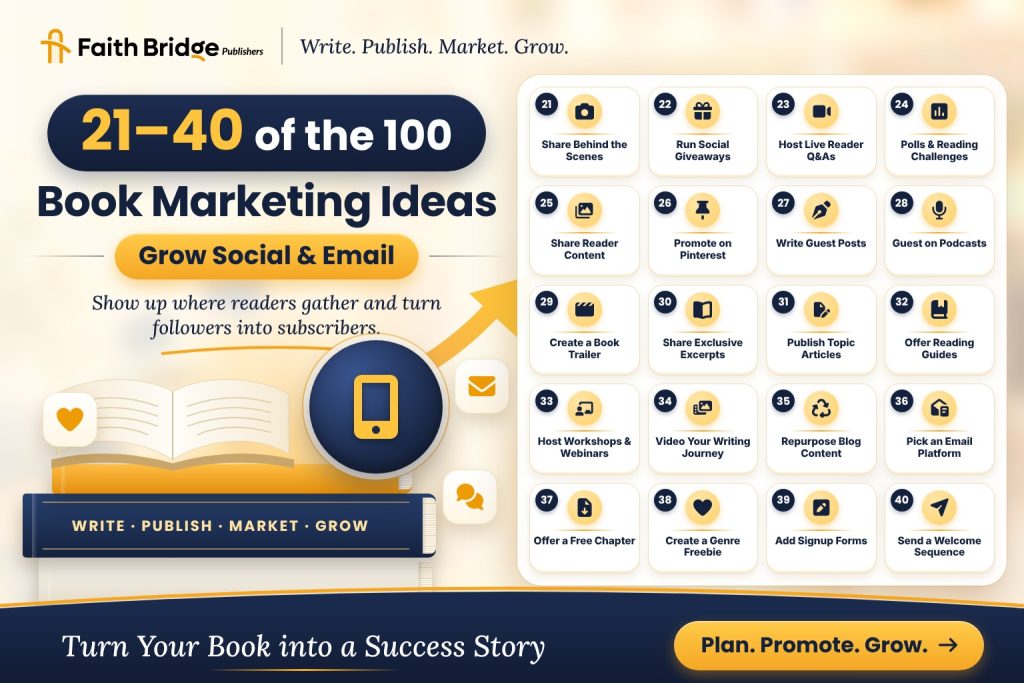
21. Share Behind the Scenes Writing Content
Show drafts, research notes, edits, and cover tests. Readers love seeing how a book gets made, and it builds trust before launch. Keep it honest. Share a messy page, not a perfect one.
Best for authors who enjoy talking about their process.
22. Organize Social Media Giveaways
Giveaways grow reach fast, but only if the prize fits your book. Give away a signed copy, not a gift card, so entrants are real readers. Post the rules, end date, and winner method. Follow each platform’s contest rules.
Best for authors with a small budget and a clear reader type.
23. Host Live Reader Q&A Sessions
Go live on Instagram, YouTube, or Facebook and answer questions for 20 to 30 minutes. Announce the time three days early. Save the replay and cut short clips for later posts. Ask viewers to join your email list.
Best for authors with a small, active audience.
24. Run Interactive Polls and Reading Challenges
Polls let readers pick a cover, a title, or the next topic. Reading challenges, like a 30 day devotion plan, bring people back daily. Both give you free market research and shareable posts.
Best for fiction authors and faith based authors with study guides.
25. Share Reader Generated Content
Reader generated content means photos, reviews, and posts from fans. Ask readers to tag you, then reshare with permission. A real shelf photo often beats a polished ad. Give credit every time.
Best for authors with a small but active fan base.
26. Use Pinterest to Promote Book Covers and Quotes
Pinterest works like a visual search engine. Create pins with your cover, a quote, and a link to your landing page. Add keyword rich titles. Pins can be found through search long after you post them.
Best for nonfiction, romance, and faith authors with visual quotes.
Use Content Marketing to Attract Potential Readers
Content marketing means giving away useful or fun material so readers find you. It works slowly. But each piece keeps working long after you publish it.
27. Publish Guest Posts on Relevant Websites
Pitch blogs your readers already follow. Offer one specific topic, a short outline, and a link to your best writing. Ask for a bio line that points to your signup page, not only your book. Expect many no replies.
Best for nonfiction authors and expert writers.
28. Appear as a Guest on Author Podcasts
Pitch shows whose listeners look like your readers. Send your media kit, three topic ideas, and a clip of you speaking. Prepare one call to action, like a free chapter. Record in a quiet room with a decent microphone.
Best for confident speakers and nonfiction authors.
29. Create a Book Trailer
A trailer is a 30 to 60 second video that sells the mood of your book. Use text on screen, your cover, and music you have rights to. Post it on your site, YouTube, and in ads. Check music licenses first.
Best for fiction authors planning a launch.
30. Share Exclusive Book Excerpts
Share the first chapter or a strong scene. Put it on your landing page, in ads, and in newsletter swaps. End on a cliffhanger with a buy link. In KDP Select, do not post large parts of the book free elsewhere.
Best for authors with a gripping opening.
31. Publish Articles Related to Your Book’s Subject
Write about the topic, not only the book. A grief book can inspire posts on coping, support groups, or faith questions. Publish on your own site first, then share on Medium or LinkedIn with a link back.
Best for nonfiction and memoir authors.
32. Create Downloadable Reading Guides
A reading guide helps book clubs and church groups. Add discussion questions, key themes, and a short author note. Offer it as a PDF in exchange for an email address. Deliver it with BookFunnel or your email tool.
Best for authors targeting book clubs, schools, and small groups.
33. Host Online Workshops and Webinars
Teach one useful skill for 45 minutes, then pitch your book briefly. Use Zoom or YouTube Live. Collect signups with a form, then email the replay. A workshop proves your expertise, which builds trust faster than ads.
Best for nonfiction authors, coaches, and ministry writers.
34. Share Your Writing Journey Through Video
Post short videos about your writing process, setbacks, and wins. Honest stories draw readers who root for you. Keep each clip under two minutes. Add captions and one clear next step.
Best for authors comfortable on camera.
35. Repurpose Blog Content Across Multiple Channels
Turn one blog post into a newsletter, five short posts, a video, and a pin. You save time and meet readers on their favorite platforms. Change the format, not the facts. Link every version to one landing page.
Best for authors with limited time.
Build an Email List and Turn Subscribers into Readers
Author David Gaughran calls email “the heartbeat of my author business.” Joanna Penn says writers who take their career seriously need a list. Social platforms can change the rules overnight. Your list stays with you.
36. Choose an Email Marketing Platform
Start free. MailerLite’s free plan allows 250 subscribers and 3 active automations. Kit’s free plan allows up to 10,000 subscribers but no automations. Compare both in the table below.
Best for new authors comparing free tools.
| Tool | Free plan | First paid plan | Good for |
| MailerLite | 250 subscribers, 2,500 emails a month, 3 automations | Comfort from $12 a month | Simple setup and landing pages |
| Kit | Up to 10,000 subscribers, no automations | Creator about $33 a month billed yearly for 1,000 subscribers | Growing lists and digital sales |
| BookFunnel | None, but a 30 day refund | $30 a year delivers files only. $20 a month adds email collection | Delivering free books and ARCs |
Prices checked on November 4, 2026. Plans change, so confirm before you buy.
37. Offer a Free Chapter as a Lead Magnet
A lead magnet is a free gift for an email address. A strong first chapter works well. BookFunnel can deliver it, though its $30 a year plan only sends files. Email collection and list connections start at $20 a month.
Best for authors with a full book to sample.
38. Create a Genre Specific Reader Freebie
Match the gift to your genre. Romance readers like a bonus scene. Mystery readers like a prequel short story. Faith readers like a devotion or study guide. A matching gift attracts the right subscribers, not freebie hunters.
Best for authors building a list around one genre.
39. Add Newsletter Sign Up Forms to Your Website
Place a signup form on your homepage, blog posts, and book pages. Ask only for a name and email. Say what readers get and how often you will write. Add a thank you page that links to your book.
Best for every author with a website.
40. Send a Welcome Email Sequence
A welcome sequence is a set of automatic emails sent after signup. Email one delivers the gift. Email two tells your story. Email three shares your best book. MailerLite’s free plan allows 3 active automations, while Kit needs a paid plan for sequences.
Best for authors with a free gift and one book to sell.
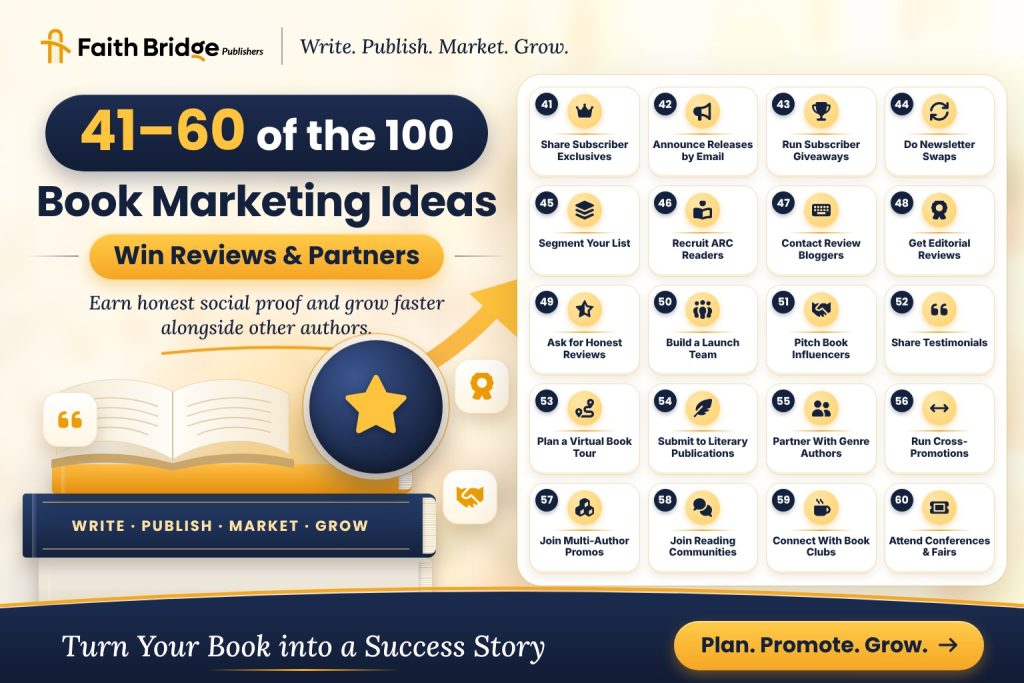
41. Share Exclusive Content With Subscribers
Give subscribers something others do not get, like early chapters, cover votes, or behind the scenes notes. It rewards people for staying and builds a launch team. Keep emails short, warm, and useful.
Best for authors with a small, loyal list.
42. Announce New Releases Through Email
Send three emails. One shares the date. One goes out on launch day with a direct buy link. One thanks buyers and asks for an honest review. Skip the link maze, because every extra click loses readers.
Best for all authors with a list, even a small one.
43. Run Subscriber Only Book Giveaways
Give signed copies or ebooks to subscribers only. It rewards loyal readers and costs little. Pick winners at random, post the rules, and ship fast. A simple form or giveaway tool can run the entry process.
Best for authors who want to reward fans.
44. Collaborate on Newsletter Swaps
In a swap, you mention another author’s book in your email and they mention yours. Pick authors with a similar genre and list size. BookFunnel’s Author Swaps feature is on all its author plans.
Best for authors with a small, engaged list.
45. Segment Your Email List by Reader Interests
Segmenting means sorting subscribers into groups. Use tags like romance reader, devotional reader, or buyer. Then send each group the right email. Kit and MailerLite both support tags and segments on free plans.
Best for authors with more than one genre or book.
Get More Book Reviews and Build Social Proof
Reviews follow quality. If readers spot typos, no tactic will save you. So use the best book editing services you can afford before you ask for reviews.
Then follow Amazon’s rules. Per Kindlepreneur, free advance copies are allowed. But you cannot swap reviews with other authors or ask family and close friends to post one.
46. Recruit Advance Reader Copy (ARC) Readers
An ARC is a free early copy for readers who may review it. Amazon allows reviews of free ARCs, but you cannot require a review or a rating. BookSirens charges $10 plus $2 per reader. NetGalley costs far more.
Best for self published authors and small presses.
47. Reach Out to Book Review Bloggers
Search Goodreads and Instagram for bloggers who review your genre. Read their review policy first. Send a short, personal email with your cover, a two line pitch, and the file format they accept. Never demand a review.
Best for authors with a few weeks before launch.
48. Submit Your Book to Editorial Review Platforms
Paid editorial reviews exist, like Kirkus Indie, which lists a standard review at $425 and takes 7 to 9 weeks. Paying does not buy praise. Use these only if you plan to quote the review in your marketing.
Best for self published authors seeking library and trade credibility.
49. Request Honest Reviews From Existing Readers
Add a short review request at the end of your book and in your thank you email. Say honest reviews help other readers. Link straight to the review page. Never offer money or gifts for a review.
Best for authors with an existing readership.
50. Build a Dedicated Book Launch Team
A launch team is a group of fans who help spread the word. Invite them by email, give early access, and share one simple task list. Tell them to post only honest opinions. A private email list or Facebook group works.
Best for authors with an engaged list.
Your Book Deserves More Than Just a Great Launch!
Getting readers to notice your book takes more than a few promotional posts. Faith Bridge Publishers helps Christian authors build meaningful connections with readers through tailored book marketing strategies.
Discover How We Can Help Market Your Book51. Pitch Your Book to Book Influencers
Look for micro influencers, meaning creators with small but loyal followings. Check that their audience matches yours. Offer a free copy with no review strings attached. In the US, FTC rules require influencers to disclose gifts.
Best for fiction authors and lifestyle or faith nonfiction authors.
52. Share Positive Reader Testimonials
Pull one strong line from a review or email and turn it into a graphic. Use it on your cover page, ads, and landing page. Get permission for emails and private messages. Quote readers exactly.
Best for authors with a few real reviews.
53. Organize a Virtual Book Tour
A virtual book tour is a set of blog posts, podcasts, and live chats over one or two weeks. Book the stops early, send each host custom content, and track traffic with unique links.
Best for authors with a firm launch date.
54. Submit Your Book to Literary Publications
Send excerpts or essays to literary magazines, church newsletters, and trade publications that fit your topic. Read the submission rules first. A byline in the right place sends qualified readers and gives you a quote for your media kit.
Best for literary authors and nonfiction experts.
What Review and Visibility Options Cost?
| Option | Cost | What you get | Watch out for |
| Honest launch team | Free | Early readers and feedback | Never require a review |
| BookSirens | $10 plus $2 per reader | Genre matched readers | Reviews are not guaranteed |
| NetGalley | About $450 to $575 for six months | Librarians, bloggers, and booksellers | Pricey for indie authors |
| Kirkus Indie | $425 standard | A paid editorial review | Paid does not mean positive |
| Goodreads Giveaway | $119 standard, $599 premium | Up to 100 copies and Want to Read adds | Many winners never review |
Sources include FreeISBN, Get My Book Reviewed, Ooligan Press, and Self Pub Hub. Prices change, so confirm before you pay.
Collaborate With Authors, Influencers, and Publishing Communities
You do not have to grow alone. Other authors already own the readers you want. Faith based writers should also study top christian book publishers. Look at how they package study guides, sample chapters, and small group tools, then adapt what fits your book.
55. Partner With Authors in Your Genre
Find three authors with similar readers but different books. Promote each other through newsletters, joint posts, or a shared giveaway. Keep it fair. Match audience size, and agree on dates and links in writing.
Best for authors with a small list.
56. Organize Cross Promotional Campaigns
A cross promotion trades visibility. Examples include a bundle post, a shared reading challenge, or a joint live event. Write a one page plan with goals and dates. Use separate tracking links to see who sent clicks.
Best for series authors and indie author groups.
57. Join Multi Author Book Promotions
Group promos put many books on one page, and readers pick their freebies. BookFunnel supports group promos on all author plans. Choose promos with clear rules on how your new subscribers can be used.
Best for authors growing a list fast.
58. Participate in Online Reading Communities
Join Goodreads groups, Reddit book forums, and Facebook reader groups. Read the rules, then take part as a reader first. Share your book only where allowed. Being helpful earns more trust than constant pitching.
Best for authors who enjoy conversation.
59. Connect With Book Clubs
Search library boards, Meetup, church bulletins, and Facebook for clubs. Offer a free reading guide and a short video Q&A. Clubs buy in groups, so one yes can bring many readers at once.
Best for fiction and faith authors with discussion topics.
60. Attend Literary Conferences and Book Fairs
Conferences let you meet editors, agents, and readers face to face. Check ticket and booth fees before you book. Bring a media kit, cards with a QR code to your signup page, and a short pitch.
Best for traditionally published authors and serious indie authors.
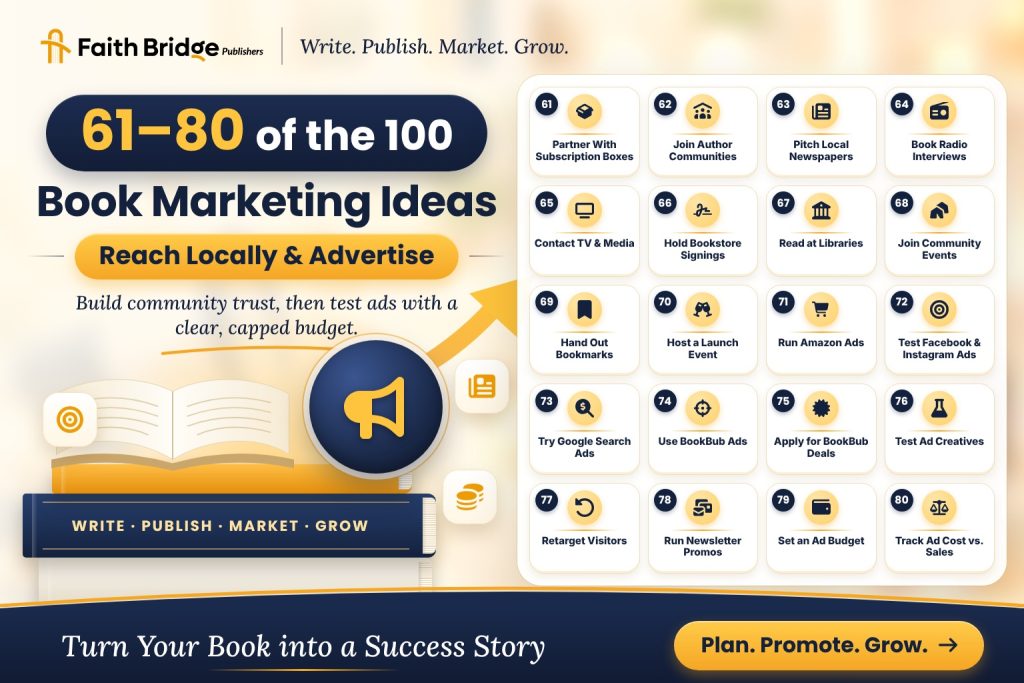
61. Collaborate With Book Subscription Boxes
Subscription boxes ship books or book themed gifts to members. Contact box owners with a clear offer, like signed bookplates or a discount. Ask about minimum orders and deadlines. Expect to cover your own copies.
Best for authors with print books and a themed brand.
62. Participate in Online Author Communities
Groups like the Alliance of Independent Authors share market news and advice. Join one, ask questions, and answer others. You will hear about scams, tool changes, and promo tips sooner.
Best for new authors who want peer support.
Promote Your Book Through Traditional and Local Marketing
Local media can feel old school. It still builds trust, especially for faith and community topics. And it costs far less than ads.
63. Pitch Your Book to Local Newspapers
Write a short press release with a local angle, like a hometown author or a community story. Include a headline, two quotes, a cover image, and a contact line. Email the right reporter, not a general inbox.
Best for authors with a local or community story.
64. Arrange Local Radio Interviews
Email local radio hosts and pitch a topic, not only a book. Prepare three talking points and a 20 second book pitch. Ask for the show link so you can share it afterward.
Best for nonfiction authors and local event authors.
65. Contact Television and Media Outlets
Local TV wants a visual, timely story. Pitch a segment with a demo, a seasonal tie in, or a charity link. Send a one page pitch and a short video. Expect a no, and follow up once.
Best for authors with a timely, visual hook.
66. Organize Book Signings at Local Bookstores
Contact the event manager at least a month ahead. Ask how the store orders books, since many prefer titles they can buy through a distributor. Promote the event to your list and bring a sign up sheet.
Best for authors with print books in distribution.
67. Arrange Readings at Public Libraries
Libraries often host author talks and book clubs. Email the programming librarian with a short talk idea and a copy of your book. Offer the talk free. Ask if the library can add your book to its shelves.
Best for authors with a topic that suits a community talk.
68. Participate in Community Literary Events
Look for book festivals, farmers markets, church events, and school fairs. Bring a banner, price list, and card reader. Add a signup sheet or QR code to grow your email list at every event.
Best for authors with print copies on hand.
69. Distribute Professional Bookmarks and Flyers
Print bookmarks with your cover and a QR code to your landing page. Leave them in coffee shops, libraries, and bookstores that allow it. Ask first. Use a unique link so you can count scans.
Best for authors on a small budget.
70. Host an In Person Book Launch Event
Pick a venue where your readers already go, like a church hall or bookstore. Plan a short reading, a signing, and a clear way to buy. Invite people by email two weeks ahead. Collect emails at the door.
Best for authors with a local fan base.
Invest in Paid Advertising to Increase Book Sales
Paid ads can sell books. They can also drain your bank account fast. Before you hire anyone, compare the best book marketing services on price, proof, and contract terms. Then test small. Author Mike Grist spent $530 on a Facebook test and earned $310 back. Track cost per sale, not clicks. These book advertising ideas all start with a capped budget.
71. Launch Amazon Sponsored Product Ads
Sponsored Products are pay per click ads in Amazon search results and on book pages. You set your own budget and pay only when someone clicks. Start with an automatic campaign to find keywords. Watch ACoS, which is ad spend divided by ad sales.
Best for KDP authors and some traditionally published authors.
72. Create Facebook and Instagram Ad Campaigns
Run a small test first. In a 2016 test, Nicholas Rossis spent $45.75 on a Facebook ad and gained 28 subscribers, about $1.63 each. Test two images and two headlines. Send traffic to a landing page with a free gift.
Best for authors with a free gift and a landing page.
73. Experiment With Google Search Ads
Google search ads show when people type a phrase, like books about grief. Intent is high, but common phrases can cost more per click. Start with a tight keyword list, a low daily cap, and one landing page.
Best for nonfiction authors with problem based topics.
74. Promote Your Book Through BookBub Ads
BookBub Ads let you target readers of similar authors. Ads run on an auction, so your cost depends on competition. Test cover images, check clicks, and adjust bids every week.
Best for authors with a series or a strong first book.
75. Apply for BookBub Featured Deals
A Featured Deal puts your discounted book in BookBub’s daily email. Submitting is free. The fee is flat and depends on category, price, and region. Acceptance is selective, so apply with strong reviews and a deep discount.
Best for authors with a series or strong backlist.
| Category | Free deal fee | 99 cent fee | $1 to $2 fee | Average clicks, free deals | Average clicks, paid deals |
| Christian Nonfiction | $465 | $628 | $1,173 | 6,400 to 9,200 | 1,150 to 2,000 |
| Christian Fiction | $309 | $379 | $728 | 9,600 to 11,700 | 1,100 to 1,750 |
Source is BookBub’s pricing page. BookBub says click ranges cover the middle half of recent promotions and are not a promise. Do the math first. A $628 fee needs many sales or strong series read through to pay back.
76. Test Different Book Ad Creatives
Creative means the image, headline, and text. Among book advertisement ideas, creative testing costs the least. Change one thing at a time, like the cover crop or first line. Run each version long enough to compare clicks and sales.
Best for anyone running paid ads.
77. Retarget Visitors Who View Your Book Page
Retargeting shows ads to people who already visited your page. Install the Meta pixel on your own site, then build an audience of visitors. You cannot add a pixel to Amazon pages, so send traffic to your landing page first.
Best for authors who sell direct or drive web traffic.
78. Run Paid Newsletter Promotions
Paid promo sites email discounted books to bargain readers. Prices depend on list size and genre, so check each price chart. BookBub says its Free Reads tier costs less than Featured Deals.
Best for authors running free or discount deals.
79. Set a Realistic Book Advertising Budget
Set your loss limit before launch. Start with a small daily budget, like $5 to $10, and raise it only after you see profit. Never spend rent money. Ads may not pay back on book one but can pay back across a series.
Best for every author starting paid ads.
80. Track Advertising Costs Against Book Sales
Compare royalty per sale to ad cost per sale. A $2.99 ebook pays about $2.09 at the 70% rate before delivery fees. If you pay $3 per sale, you lose money, unless read through pays you back.
Best for authors with sales data.
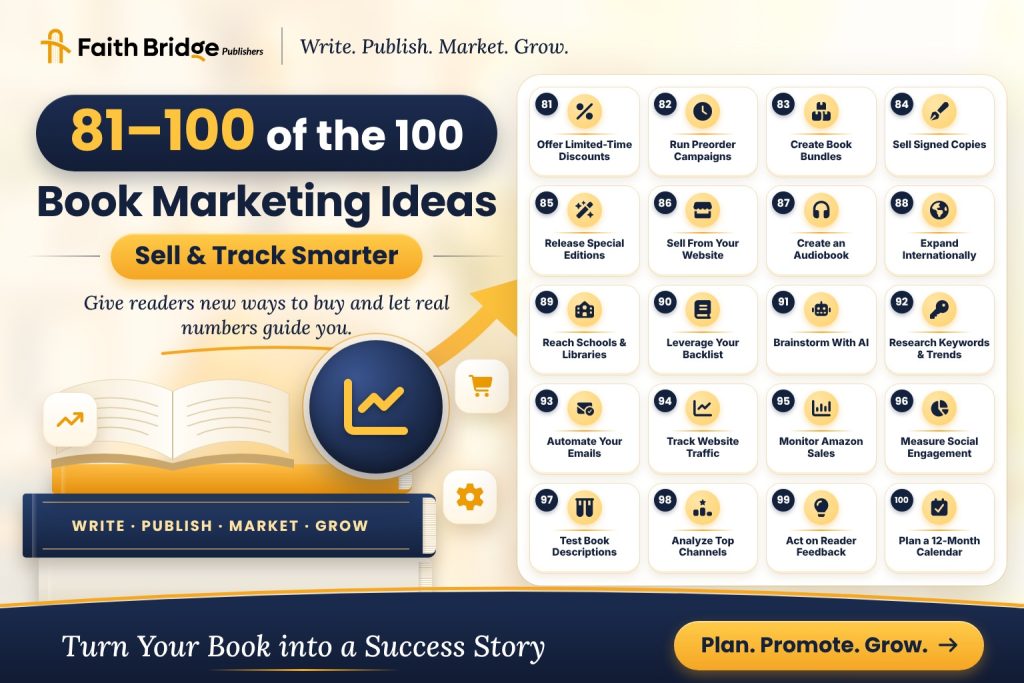
Explore Creative Ways to Generate More Book Sales
These book promotion ideas change how, where, and in what format readers buy. Some cost nothing. Others need a real budget.
81. Offer Limited Time eBook Discounts
In KDP Select, a Kindle Countdown Deal runs up to seven days at a lower price. Your list price must stay fixed for 30 days before it. You can run a Countdown Deal or free days each term, not both.
Best for KDP Select authors.
82. Promote Your Book Through Preorder Campaigns
Preorders let readers commit early and give you a link to share before launch. KDP lets you set a Kindle preorder with a release date. Share the link everywhere and send reminders.
Best for authors with a firm date and a ready email list.
83. Create Multibook Bundles
A bundle packs several books at one price. It raises order value and pulls readers into a series. KDP publishes guidelines for boxed sets and bundles in ebook format. Price the bundle below the total of the single books.
Best for series authors and authors with a backlist.
84. Offer Signed and Personalized Copies
Sell signed copies from your website or at events. State shipping costs clearly. Use bookplates if you cannot sign every copy. BookFunnel’s paid Mid List and Bestseller plans offer ebook signing.
Best for authors with loyal fans and print copies.
85. Develop Special Edition Book Releases
Special editions, like hardcovers, bonus chapters, or a leader’s guide, give fans a reason to buy again. KDP supports hardcovers. Check costs in the KDP printing cost and royalty calculator before you set a price.
Best for authors with a fan base and a strong backlist.
86. Sell Books Directly Through Your Website
Direct sales let you keep more per book and own your customer list. Shopify, Payhip, and WooCommerce can sell books. You pay processing fees and handle shipping and taxes. Kit charges 3.5% plus 30 cents per digital sale.
Best for authors with an audience and some tech comfort.
87. Create Audiobook Versions of Your Book
ACX pays 40% to exclusive authors and 25% to non exclusive authors. INaudio, formerly Findaway Voices, reaches more than 40 retailers and libraries. Compare both before you sign anything.
Best for authors with proven sales who want a new format.
88. Explore International Book Distribution
KDP ads for KDP titles run in the US, Canada, UK, Germany, Italy, Spain, France, and Australia. Test one new market at a time. Translate your description and check local pricing. Draft2Digital can reach more stores.
Best for authors with proven demand at home.
89. Offer Your Book to Schools and Libraries
Librarians often rely on trade reviews and distributor catalogs. Check whether a distributor libraries already use lists your book. Offer bulk discounts and a free teacher or discussion guide. Follow school buying rules.
Best for children’s authors and nonfiction authors with study tools.
90. Use Your Backlist to Promote New Releases
Backlist means your older books. Add a preview of your new book to the back matter of old ones, with a link. Run a discount on book one when book two launches. BookBub says partners often use Featured Deals to drive backlist revenue.
Best for authors with two or more books.
Use Technology and Analytics to Improve Your Book Marketing
Data stops you from guessing. Reedsy’s guide to Facebook ads, written by Mark Dawson, calls ad spend “an investment you should be happy to make” when revenue beats it. You only know that if you track.
91. Use AI to Brainstorm Marketing Campaigns
Use AI to brainstorm hooks, ad variations, and email subject lines. Always edit the output and fact check every claim. Read a tool’s data policy before you paste in an unpublished manuscript. Your voice should still sound human.
Best for authors who need many headline options fast.
92. Research Book Keywords and Search Trends
Use Amazon search suggestions, Google Trends, and Google autocomplete. Type your topic and note the phrases that appear. Use those phrases in your title, subtitle, and keywords if they fit honestly. Misleading keywords can get a listing flagged.
Best for self published authors on Amazon.
93. Automate Your Email Marketing Campaigns
Automation sends emails when a reader takes an action, like signing up. Build one welcome sequence and one buyer thank you flow. Check them each quarter for dead links. MailerLite’s free plan allows 3 active automations of up to 5 steps.
Best for authors with a growing email list.
94. Track Website Traffic With Google Analytics
Google Analytics shows where visitors come from and what they click. Set up an event for clicks on your buy button. Add UTM tags, which are labels at the end of a link, so you can see which post or ad sent each visit.
Best for authors with a website and regular posts.
95. Monitor Your Amazon Book Sales
KDP reports show orders, royalties, and Kindle Edition Normalized Pages (KENP) read. Check them weekly. Compare sales to your promo and ad dates. Amazon Ads reports show only ad linked sales, while KDP reports show all sales.
Best for KDP authors.
96. Measure Social Media Engagement
Likes feel good but pay no bills. Track link clicks, saves, shares, and email signups from each platform. Instagram, TikTok, and YouTube include free analytics. Drop any platform that sends no clicks after 90 days.
Best for authors who post often with little result.
97. Test Different Book Descriptions
Change one thing, like the first line, and watch your sales page conversion. You can edit KDP descriptions anytime. Give each version at least two weeks and similar traffic before you judge it. Keep a simple change log.
Best for authors with steady traffic to a book page.
98. Analyze Your Most Successful Marketing Channels
Once a month, list each channel, money spent, time spent, and sales or signups. Divide cost by results. Cut the weakest channel and add effort to the strongest. Small samples can mislead, so wait for enough data.
Best for authors using three or more channels.
99. Update Your Marketing Strategy Based on Reader Feedback
Read reviews, emails, and replies for repeated words. If readers say slow start, fix your sample and description. If they love the setting, put it in your ads. Reader language is free copywriting.
Best for authors with reviews and email replies.
100. Create a Long Term Book Marketing Calendar
Map the next 12 months by quarter. Pin launches, promos, newsletters, and KDP Select renewals. Add one monthly review day. Leave open slots for chances you cannot predict. A calendar prevents panic marketing.
Best for every author, especially series writers.
How to Choose the Right Book Marketing Ideas for Your Budget and Genre?
You do not need all 100. Pick by goal, budget, and publishing path. Start with free options, and spend money only where you can measure the result.
Free and Paid Options Side by Side
| Goal | Free option | Paid option and cost |
| Build an email list | MailerLite free for 250 subscribers or Kit free for 10,000 | MailerLite from $12 a month, Kit about $33 a month billed yearly |
| Get reviews | Launch team and honest ARC readers | BookSirens at $10 plus $2 per reader, NetGalley at about $450 to $575, Kirkus Indie at $425 |
| Reach new readers | Social posts, guest posts, library talks | BookBub Featured Deals from $309 to $1,173 in Christian categories, Goodreads Giveaways at $119 or $599 |
| Sell on Amazon | Better metadata, description, and KDP Select promos | Sponsored Products, pay per click with your own budget |
Costs come from the sources linked earlier. Check each site before you buy.
Self Published and Traditionally Published Authors
| Area | Self published | Traditionally published |
| Price and royalty | You set the price and choose the KDP ebook royalty option | The publisher usually sets price, so check your contract |
| Amazon ads | KDP titles can run ads in eight listed countries | Books published outside KDP can run ads in listed countries too |
| Promotions | KDP Select adds 90 day exclusivity with Countdown Deals or free days | Ask your publisher before any discount or giveaway |
| Email list, website, and social | You build all of it | Still yours to build, so start early |
Book Marketing Tips by Genre
Faith and Christian nonfiction authors can lean on reading guides, church and small group outreach, and webinars. BookBub lists average paid click ranges of 1,150 to 2,000 for Christian Nonfiction deals. Fiction authors can lean on BookTok, reels, and newsletter swaps. Nonfiction experts can lean on guest posts, podcasts, and search content.
Your 90-Day Book Marketing Plan
A good book marketing plan is small, timed, and tracked. Use this one as a starting point and adjust it to your budget.
| Phase | Days | Do this | Track this |
| Foundation | 1 to 30 | Fix the cover, description, and metadata. Set up an email tool and landing page. Write your free gift. Recruit ARC readers. | Signups and ARC readers recruited |
| Launch | 31 to 60 | Send three launch emails. Post three times a week on one platform. Start a small ad test with a capped daily budget. Ask for honest reviews. | Sales, cost per click, and reviews |
| Review | 61 to 90 | Read KDP and ad reports. Cut the weakest tactic. Test one new idea. Plan your next promo on your calendar. | Cost per sale and signups by source |
No plan guarantees sales, rankings, or results. A plan only helps you learn faster, spend smarter, and stop what is not working.
How to Measure the Success of Your Book Marketing Campaigns?
Success is not a feeling. It is a number you can compare month to month. Track a few metrics, write them down, and judge each tactic by what it earns back.
| Metric | What it tells you | Where to find it |
| Email signups | Which sources bring real fans | MailerLite or Kit reports |
| Cost per sale | Whether ads pay for themselves | Ad spend divided by KDP sales |
| Royalty per sale | What you keep on each book | KDP royalty estimator |
| Conversion rate | Share of visitors who buy or subscribe | Google Analytics |
| KENP read | Pages read in Kindle Unlimited | KDP reports |
| Reviews and ratings | Reader trust | Amazon and Goodreads |
| Click ranges | Whether a promo reached enough readers | BookBub dashboard |
Real Author Test Results
Numbers beat opinions. Here are real tests from authors and platforms.
| Test | Spend | Result | Lesson |
| Nicholas Rossis, Facebook ad in 2016 | $45.75 | 28 new subscribers, about $1.63 each | Small tests can grow a list cheaply |
| Mike Grist, Facebook test | $530 | $310 earned | Clicks do not equal profit |
| Reedsy example | $10 a day | 30 new subscribers, about 33 cents each | A small daily budget can still build a list |
| BookBub Christian Nonfiction 99 cent deal | $628 fee | 1,150 to 2,000 average paid clicks | A click is not a sale, so plan the follow up |
The Big Picture
Winning the book market in 2026 takes real strategy, not just hope. You now have the exact blueprint to build a strong author brand, grow an active email list, and run profitable ads.
Stop waiting for readers to stumble upon your work. Take bold action today. Test your hooks, optimize your sales pages, and engage your community consistently.
If you want to amplify your reach even faster, team up with established Christian book marketing services or publish through trusted experts like Faith Bridge Publishers to elevate your message and turn casual browsers into lifetime readers.
Frequently Asked Questions
Promote your book through social media, email marketing, and reader communities. Share engaging posts, send updates to your subscribers, and connect with book clubs.
These simple book promotion ideas help you reach new readers, build interest, and encourage more people to buy your book.
The 3-3-3 rule is a simple approach to keeping your book marketing consistent. Focus on three platforms, share three types of content, and spend time engaging with three reader groups.
Adapt this method to your audience and include it in your book marketing plan.
Share short excerpts, character introductions, behind-the-scenes photos, reader reviews, and personal stories.
Create reels, host live sessions, and use relevant hashtags to reach potential readers. These book marketing tips help you build genuine connections and turn social media followers into loyal readers.
Try sharing character mood boards, book-inspired playlists, memorable quotes, reading challenges, author interviews, and short story teasers. You can also post writing bloopers and reader reactions.
These creative book promotion ideas give people a reason to explore your book and share your content.
Start with a catchy headline that grabs attention. Introduce your book’s main hook, highlight what makes it worth reading, and add a clear call to action.
Use emotional language and strong visuals. Effective book advertisement ideas make readers curious enough to click and buy.
The best approach depends on your genre, audience, and budget. Start with Amazon Ads, social media campaigns, and email promotions.
Test different headlines and visuals to see what attracts readers. Combine paid campaigns with organic book advertising ideas to build lasting interest.
Seven useful approaches include social media marketing, email marketing, influencer partnerships, paid advertising, content marketing, book review campaigns, and author events. Each method helps you reach readers differently.
Combine these book marketing ideas to create a balanced strategy that supports long-term book sales.
Offer limited-time discounts, organize giveaways, arrange virtual book readings, collaborate with book bloggers, and share exclusive chapters. You can also create reader referral campaigns and launch a newsletter.
Choose book marketing ideas that fit your audience and include them in your book marketing plan.
Ready to Turn These Ideas Into a Real Launch Plan?
Not sure where to begin? Talk with Faith Bridge Publishers about christian book marketing services and get a plan built around your book, your budget, and your readers.
Book a Consultation